In a saturated digital world, where the competition for attention is ever fiercer, the strategy of long tail appears as an essential compass for professionals in the digital marketingWhile most companies seek to rank for generic keywords, understanding and skillfully using long, precise, and often overlooked phrases not only generates more qualified traffic but also effectively increases conversion rates. By 2026, this methodology will emerge as a powerful tool for deciphering and effectively addressing the…purchase intention consumers, who express their needs through increasingly specific searches.
While more than 70% of organic search queries belong to this specific category of keywords, their weight in the customer segmentation is crucial. This approach is not merely technical; it transforms the way companies orchestrate their business strategy by incorporating an in-depth analysis of purchasing behaviorsAddressing the long tail also means embracing the complexity of user journeys and adapting your content to best meet the expectations of your target audience, while remaining competitive against industry giants. Here’s a detailed analysis to grasp all the nuances and benefits of this strategy.
Long tail: SEO definition and relevance in keyword analysis
Understanding the concept of long tail SEO is essential to understanding its impact on traffic and the conversionThis concept, popularized by Chris Anderson in 2004, is based on the idea that the majority of traffic does not come from a few highly popular keywords, but rather from thousands of specific phrases with low individual search volumes. These terms, often composed of three to seven words, express a clear and targeted intent, precisely matching what an internet user is searching for.
In practice, rather than trying to rank for a generic term like “shoes,” a retailer can target phrases such as “women’s waterproof hiking boots size 40.” Even if this type of query receives fewer searches, the sum of these specific targeting efforts generates a considerable flow of passionate, purchase-ready visitors. business strategy then becomes more focused, relying on a keyword analysis precise in order to identify these market niches.
A major advantage of the long tail lies in reducing competition, particularly against e-commerce giants or comparison shopping engines. For example, a company selling smartwatches will benefit more from ranking for “40mm waterproof GPS smartwatch” rather than simply “smartwatch.” This precision improves both organic visibility and reduces advertising costs thanks to a targeting more efficient and less contested.
From a purely SEO perspective, long-tail keywords also contribute to building a website’s thematic authority. By developing relevant content around very specific queries, the site gains consistency in algorithm crawling, strengthening its reputation within its sector. This network of targeted keywords perfectly aligns with evolving purchasing behaviors, particularly with the rise of voice search, which now favors conversational and detailed queries.
To fully exploit this approach, it is crucial to build a rich lexical ecosystem of similar terms and extended expressions, which better meets the intentions of internet users and generates qualified traffic with a conversion rate superior. The long tail is therefore not limited to simple referencing, but is essential as a pillar of the digital strategy that combines visibility and commercial performance.
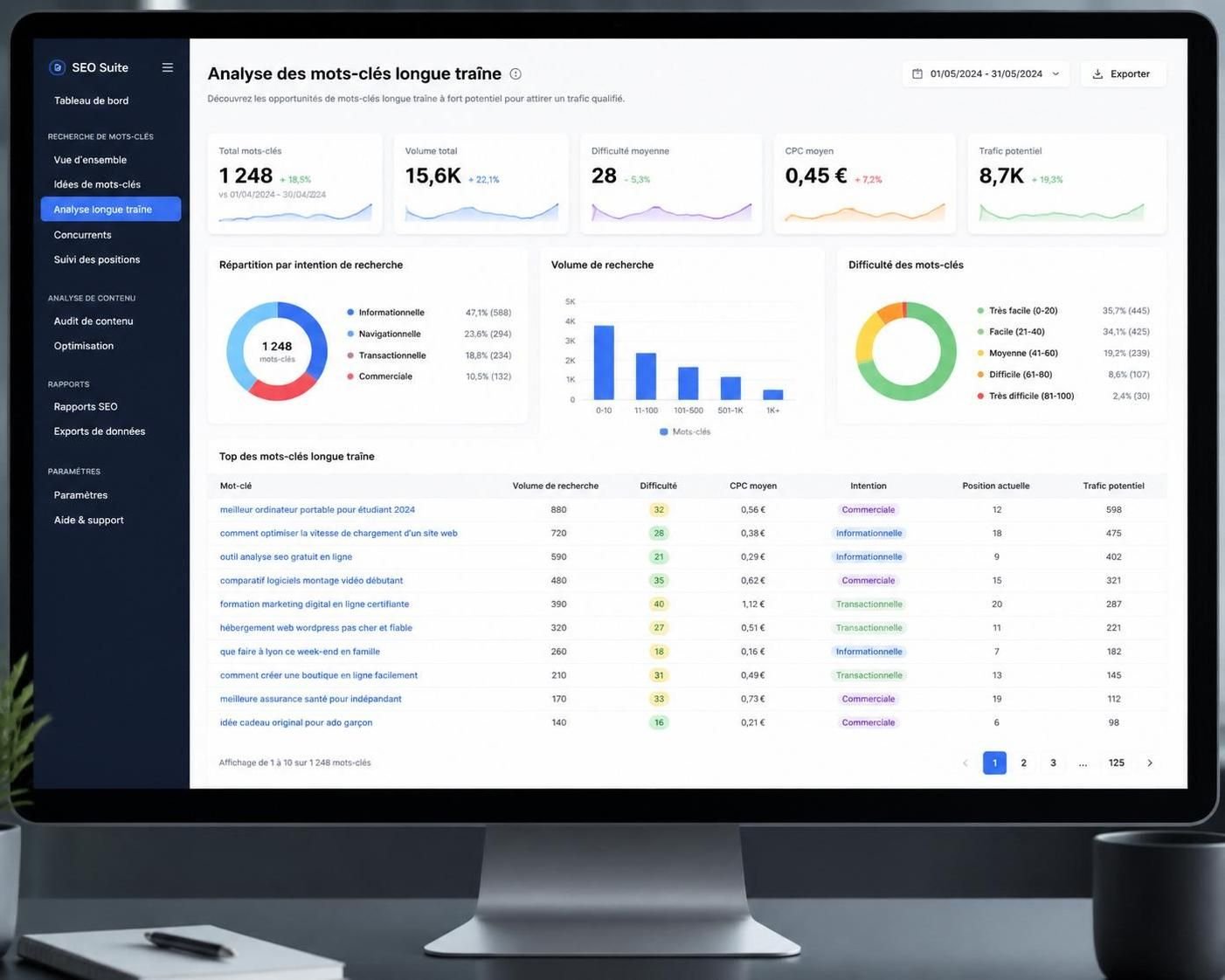
Implementing an effective long-tail strategy to maximize purchase intent
Deploying a long-tail strategy requires adopting a rigorous methodology that delivers tangible results. It all starts with a keyword analysis geared towards finding precise, low-volume expressions with high conversion potential. This work is structured in several stages:
- Identifying main themes Understanding the major categories of your offer is the first step, to then derive longer and more specific expressions that fit with the real intention of buyers.
- Extraction of long-tail variants : Thanks to tools like Semrush, Ahrefs or Google Suggest, you get a range of precise expressions that your potential customers use.
- Relevance assessment Each query is analyzed according to its volume and competition to identify those that offer the best balance in terms of SEO profitability.
- Prioritization and integration The selected keywords are then integrated into the editorial calendar to guide content creation.
- Optimization and monitoring As content is published, traffic and conversion data must be analyzed to adjust targets and messages.
A company that sells sports accessories, for example, can leverage dedicated pages such as “high-waisted yoga leggings with pockets” or “lightweight and waterproof hiking backpacks.” This targeting ideally addresses a specific intent, avoiding both dispersion and direct competition.
The use of technologies incorporating artificial intelligence modernizes and facilitates this segmentation and targetingSome advanced solutions, like Sedestral, automate the detection of relevant long-tail keywords from your product catalog, categorizing these queries according to their intent—informational, decision-making, or transactional. This classification is essential for perfectly tailoring your content, whether it’s a product page, blog post, or FAQ page.
Beyond identification, technical implementation plays a key role. Major platforms such as Shopify and PrestaShop now integrate modules that allow for the automatic application of long-tail keywords to titles, meta descriptions, and content, thus boosting SEO without the burden of manual management. This helps maintain a continuous flow of qualified visits and encourages optimal conversion.
It is also essential to anticipate seasonal or emerging market trends through regular monitoring using Google Trends or Search Console. By 2026, this ability to react quickly will become a decisive competitive advantage against sectors struggling to refresh their content.
Organizing SEO architecture to amplify the impact of long-tail keywords
The effectiveness of a long-tail strategy doesn’t stop at selecting specific keywords; it also relies on the overall site architecture. A well-organized structure promotes the distribution of “SEO juice” and enhances the site’s expertise in the eyes of search engines.
The implementation of thematic clusters or siloed page structures are particularly recommended. This involves building a coherent whole where a pillar page covers a broad topic, supported by several satellite pages focused on specific subtopics. This hierarchical approach facilitates understanding of your content and user navigation, while also improving SEO.
For example, in an online store specializing in hiking equipment, a pillar page might feature a “Hiking Shoe Guide,” while satellite pages could detail “shoes for men with flat feet” or “waterproof hiking shoes for women.” Strategic internal linking connects these pages, enriching the topic and optimizing search engine ranking.
In practice, this organization requires limiting the navigation depth to a maximum of three clicks, ensuring a smooth experience and efficient indexing by Google. Furthermore, the URL structure must clearly reflect the semantic hierarchy, incorporating relevant long-tail keywords; a URL like “/shoes/hiking/women’s-raincoat-size-40” thus provides optimal readability.
A summary table illustrates best architectural practices for a high-performing long tail:
| Element | Good practice | SEO impact |
|---|---|---|
| Pillar pages | Extensive content, comprehensive guides | Strengthened thematic authority |
| Satellite pages | Specific, targeted requests | Increased qualified traffic |
| Internal network | Contextual links leading back to the pillar pages | Better crawling and SEO juice distribution |
| Navigation depth | Maximum 3 clicks from the homepage | Improving the user experience |
| URLs | Integration of long-tail keywords | Clarity and semantic relevance |
This holistic approach, combining structure and targeted lexicality, gives the long tail its full power to generate qualified traffic and high conversion, while sustainably consolidating the site’s visibility in its segment.
Optimizing product pages with long-tail keywords to increase conversion
Product pages represent the culmination of any sales-oriented long-tail strategy. Their targeted optimization significantly improves the conversion by perfectly meeting the purchase intent expressed by the specific searches.
Integrating long-tail keywords into titles is crucial. Rather than opting for “smartwatch,” a precise formulation such as “Galaxy Watch Smartwatch – Bluetooth, GPS and 40mm water resistance” not only attracts more qualified traffic but also facilitates the purchase decision.
Beyond the title, the product description should naturally use synonyms and variations to cover a wide range of related phrases. For example, a description for hiking backpacks could include “waterproof backpack for long-distance trekking” and “lightweight bag with multiple compartments,” thus optimizing SEO reach.
Furthermore, technical aspects should not be overlooked. Giving each image a descriptive filename and carefully filling in ALT tags with long-tail keywords helps capture traffic through image search or voice search. Adopting Schema.org structured markup improves visibility in rich results, displaying ratings, prices, and FAQs, thus enhancing the attractiveness of pages in SERPs.
A list of key optimizations for your product pages:
- Detailed title management incorporating specific requests.
- Enriched descriptions covering all aspects and lexical variations.
- ALT tags and SEO-friendly image names.
- FAQ Implementation to capture voice search and featured snippets.
- Schema.org markup for structured data and improved display.
This approach, complemented by the use of tools like Sedestral which automates the generation of titles and descriptions, considerably lightens the workload and guarantees comprehensive coverage of each long-tail theme, thus maximizing the final conversion.
Measure and leverage the results of the long tail to drive your digital strategy
The success of a long-tail strategy is demonstrated through precise and regular analysis. It is essential to monitor not only keyword rankings, but also other revealing indicators related to purchase intent and sales performance.
Among the essential tools, Google Search Console offers a clear view of ranking and CTR for each query. Combined with specialized solutions featuring detailed dashboards, it becomes possible to track organic traffic, bounce rate, and, most importantly, the conversion generated by each keyword segment.
To facilitate decision-making, here is a table of key indicators to monitor continuously:
| Indicator | Tracking frequency | Critical threshold | Recommended actions |
|---|---|---|---|
| Average keyword ranking | Weekly | Over 50 | SEO audit and internal linking |
| Bounce rate | Weekly | Greater than 70% | Content review or UX |
| CTR in SERP | Weekly | Less than 2% | Rewriting of titles and meta descriptions |
| Conversion rate | Monthly | Below the industry benchmark | Product sheet optimization |
| Search volume | Monthly | Increase of +20% | Rapid creation of targeted content |
The automated alerts for volume changes ensure enhanced responsiveness, essential for anticipating trends before competitors fully capitalize on them. Furthermore, testing various titles and descriptions through A/B testing optimizes click-through rates and ultimately increases commercial impact.
Finally, the complementarity between SEO and SEA campaigns is a powerful lever. Identifying a long tail that performs well in paid advertising and strengthening it through organic search reduces acquisition costs while maintaining a constant flow of qualified visitors.
What is the long tail in SEO?
Long tail in SEO refers to specific and detailed search phrases, often composed of several words, that generate qualified traffic with a clear purchase intent.
Why does the long tail improve conversion?
Because it targets specific queries expressing a strong purchase intent, the long tail attracts visitors ready to make a purchase, which significantly increases the conversion rate.
What tools can be used to identify long-tail keywords?
Tools like Semrush, Ahrefs, Google Suggest and AI-based solutions such as Sedestral allow you to extract and analyze optimal long phrases for your industry.
How to organize your website to leverage the long tail?
By structuring its site into thematic clusters with a clear hierarchy (pillar and satellite pages), effective internal linking and explicit URLs integrating long-tail keywords.
Can the management of long-tail keywords be automated?
Yes, thanks to artificial intelligence, it is possible to automate detection, the generation of optimized content and performance monitoring, while retaining human control to ensure relevance.