In a global context where emerging currencies are attracting increasing attention from investors, the Mexican peso in 2026 stands out as a key currency to watch. The strength of this currency is intrinsically linked to the performance of the Mexican financial market, as well as the country’s sustained economic growth. This dynamic encourages international investment strategies to incorporate the Mexican peso to capitalize on the financial empowerment opportunities it offers. The Mexican economy, rich in diverse sectors and benefiting from an increasingly favorable regulatory framework, actively contributes to building trust among economic participants in this market, often viewed as a bridge between developed economies and emerging markets.
Faced with global uncertainties and exchange rate fluctuations, the Mexican peso demonstrates in 2026 a remarkable resilience, attracting capital into various key sectors such as manufacturing, agribusiness, and technology. This trend is accompanied by local financial reform initiatives aimed at improving transparency and facilitating foreign investment. For investors seeking to optimize their portfolios, understanding the mechanisms underpinning the transformation of the Mexican financial market is essential. An in-depth look at the national currency, its interactions with major economies, and its valuation forecasts paves the way for more strategic use of the Mexican peso in investment plans for 2026.
Key points to remember:
- The Mexican peso asserts itself as a stable and attractive emerging currency in 2026.
- The Mexican economy benefits from sustained economic growth fostering investments.
- The Mexican financial market offers diversified and dynamic investment opportunities.
- Managing exchange rates is crucial to optimizing investments related to the Mexican peso.
- Appropriate investment strategies allow to profit from the rising strength of the Mexican peso.
The Role of the Mexican Peso in the Global Financial Market in 2026
The Mexican peso occupies a strategic position in the global financial market in 2026, symbolizing both the dynamism of the Mexican economy and the growing attractiveness of emerging currencies. Its performance is largely influenced by internal factors such as political stability, economic reforms, and foreign investment flows, but also by its positioning relative to major currencies such as the US dollar and the euro.
In 2026, the Mexican peso benefits from a favorable environment where macroeconomic stability is bolstered by strict control of inflation and accommodating monetary policy. These characteristics attract international investors looking to diversify their portfolios with currencies capable of resisting turbulence caused by emerging market volatility. Confidence in the Mexican government’s ability to maintain a stable regulatory framework remains a key asset in the face of competition from more traditional currencies.
An additional key factor is the trade dependency between Mexico and the United States, a partnership that directly influences the peso’s exchange rate. For example, in 2026, the robustness of the Mexican manufacturing sector, heavily integrated into the North American supply chain, helps solidify the Mexican currency due to high export volumes. This translates into greater liquidity and a stronger position for the peso in international currency markets.
To illustrate this evolution, here is a comparative table between the Mexican peso and other key currencies regarding their volatility and performance since the start of 2026:
| Currency | Volatility (6 months) | Performance (Q1 2026) | Key Factors |
|---|---|---|---|
| Mexican peso (MXN) | Moderate | +4.6% | Economic growth and political stability |
| US dollar (USD) | Low | +1.8% | Restrictive monetary policy |
| Euro (EUR) | High | +0.5% | Geopolitical uncertainties |
These indicators clearly demonstrate that the Mexican peso combines attractive performance with controlled volatility, making it a currency of interest for investment portfolios in 2026. To deepen understanding, it is useful to explore the specific sectors supporting this growth and how they contribute to Mexico’s financial dynamism.
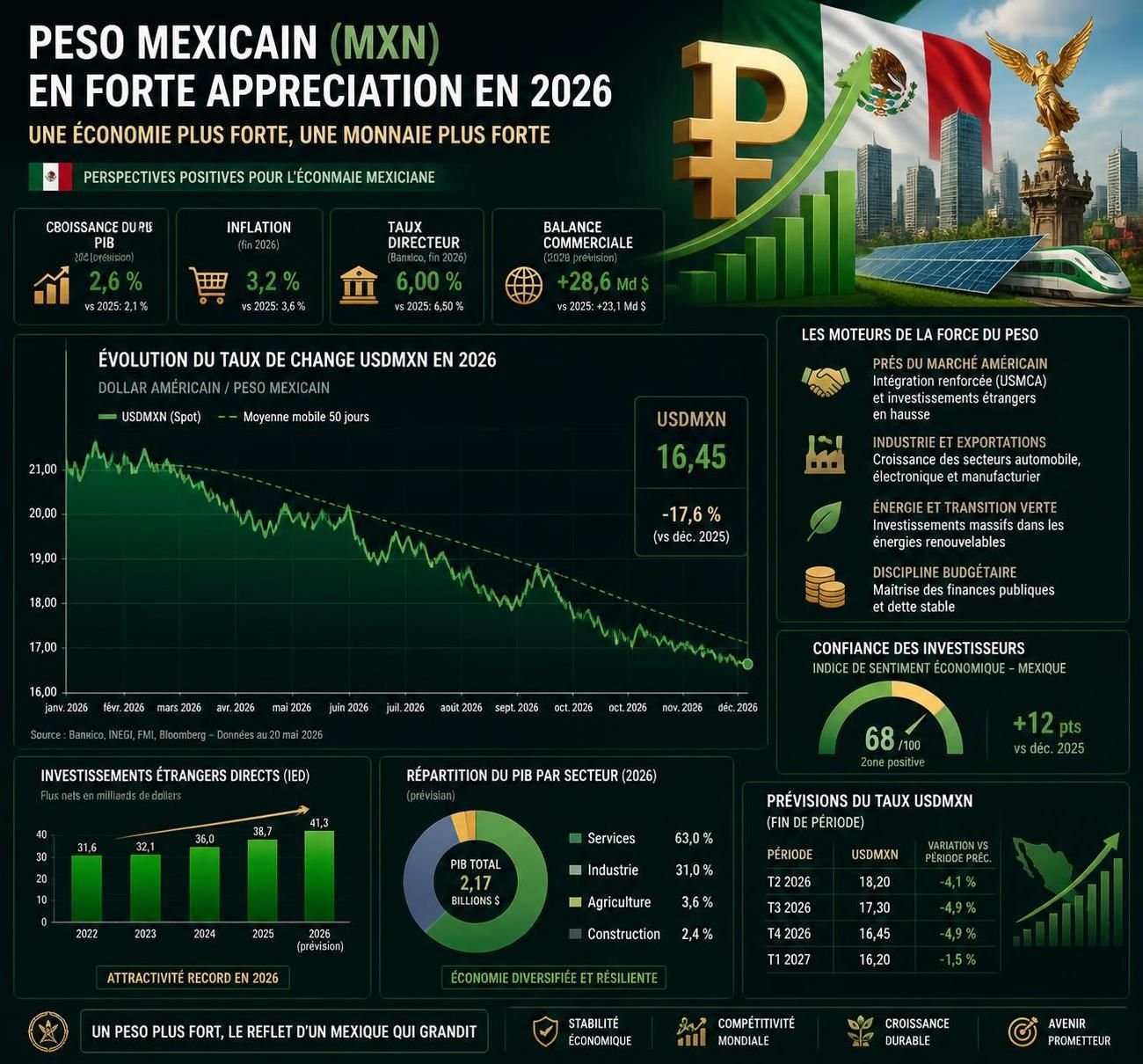
Economic Drivers Strengthening the Mexican Peso and Its Outlook for 2026
The outlook for the Mexican peso in 2026 primarily relies on the robust drivers of the Mexican economy. After several years of structural reforms, the country displays encouraging economic growth, driven by a competitive industrial sector, favorable demographics, and increased openness to international investors.
The role of the domestic market is fundamental. With a young and growing population, domestic demand stimulates many sectors, including consumption, real estate, and services. Additionally, foreign direct investment (FDI) continues to flow into innovative projects in technology and infrastructure, strengthening the country’s strategic position. The peso’s role in these transactions is therefore significant, as high demand for the national currency supports its dynamism.
The energy sector, expanded through investments in renewable energies, also makes a significant contribution. Mexico commits to addressing climate challenges while consolidating its energy independence, which increases market confidence in the local currency. In the manufacturing domain, the automotive industry remains an unquestionable pillar of economic success, with exports regularly exceeding forecasts.
Analyzing macroeconomic data reveals that Mexico’s economic growth in 2026 is estimated at around 3.5%, according to recent projections, a figure that compares favorably with the average for emerging economies. This stability is supported by controlled inflation close to 3%. These elements directly contribute to the solidity of the Mexican peso on the international market.
To better understand prospects, here is a list of the main factors positively impacting the Mexican peso in 2026:
- Political stability ensuring a conducive environment for investment.
- Economic reforms promoting infrastructure modernization.
- Trade agreements strengthened with major global powers.
- Sector diversification focusing on technology and green energy.
- Growing FDI flows supporting industrial growth.
The potential is evident, and integrating the Mexican peso into an investment strategy in 2026 appears to be a wise choice to fully leverage this momentum. For those interested in the practical applications of these trends, understanding the different investment options remains essential, especially as the Mexican financial landscape offers several suitable vehicles.
Tailored Investment Strategies for the Mexican Peso to Boost Your Portfolio
In 2026, the increasing range of investment options related to the Mexican peso provides fertile ground for portfolio diversification. The Mexican financial market, although considered an emerging currency, demonstrates maturity across various segments, including the Mexican stock exchange (BMV), sovereign bonds, and innovative local companies.
Investing directly in Mexican pesos via shares listed on the Bolsa Mexicana de Valores grants access to leading companies in strategic sectors such as consumer goods, finance, and renewable energy. This approach offers a direct participatory role in the local economy, with a significant leverage effect tied to economic growth.
Furthermore, Mexican bonds are often favored for their attractive yields and relative stability. These securities offer a safer alternative while benefiting from the strengthening of the Mexican peso. In 2026, portfolio diversification also relies on specialized emerging market funds focusing on the Mexican market due to its strong prospects.
To maximize financial empowerment, it is crucial to account for exchange rate fluctuations between the Mexican peso and other currencies. Active management of this risk, particularly through hedging instruments like options or futures contracts, becomes an essential strategy to safeguard investments while taking advantage of upward trends.
To facilitate decision-making, here is a list of key investment instruments to consider in 2026:
- Shares on the Bolsa Mexicana de Valores with a focus on growing sectors.
- Mexican sovereign bonds offering yield and stability.
- Specialized emerging market funds prioritizing the Mexican market.
- Currency derivatives for optimized risk management of exchange rates.
- Foreign direct investments in innovative sectors.
Adopting these strategies involving the Mexican peso supports diversification and addresses the challenges of a globalized financial market, while harnessing the sustainable potential of the Mexican economy. For those looking to deepen their knowledge of best investment practices in Mexico, closely monitoring updated resources remains essential.
How Exchange Rate Management Impacts Your Investments in the Mexican Peso
The exchange rate is a critical element in the equation of investing in the Mexican peso. In 2026, emerging market currency volatility is slightly managed but remains a decisive factor for the net return of investments in local currency.
Understanding the mechanisms behind exchange rate setting and anticipating its movements allows adaptation of strategies to limit losses caused by unfavorable fluctuations. The Mexican peso frequently correlates with the US dollar, which requires close monitoring of US political and economic decisions, such as the adjustments of the Federal Reserve’s key interest rates.
Institutional investors often prefer currency hedging techniques to gain exposure to the Mexican peso while limiting risks. Financial instruments such as futures, options, and swaps on currencies are effective tools for securing investments. Mastery of these instruments requires advanced expertise but ensures better performance despite global market fluctuations.
Additionally, the Mexican government in 2026 implements measures aimed at stabilizing the exchange rate, including interventions in the currency markets and enhancing transparency in international transactions. These actions help strengthen the attractiveness of the Mexican peso among foreign investors.
Below is a table summarizing the main impacts of the exchange rate on different types of investments in the Mexican peso:
| Investment Type | Impact of Exchange Rate | Recommended Strategy |
|---|---|---|
| Mexican stocks | Fluctuations in gains in foreign currencies | Partial coverage with options |
| Sovereign bonds | Moderate effect on nominal returns | Hedging through futures contracts |
| Emerging market funds | Shift in the portfolio’s breakeven point | Dynamic risk management |
Controlling these parameters is often key to transforming a standard investment into real financial success. Prudence in managing the exchange rate risk, combined with a rigorous analysis of the Mexican economy and its financial market, provides a winning and innovative approach for 2026.
Sectoral Investment Opportunities Driven by the Mexican Peso in 2026
The Mexican economy of 2026 is characterized by a diversity of promising sectors that energize the local currency and offer targeted investment opportunities. For discerning investors, focusing on these sectors represents a winning strategy within a resilient growth context and regional financial empowerment.
Among the most attractive sectors are green technologies, sustainable agriculture, high-end tourism, and innovative infrastructure. These areas align with national and global sustainable development goals, attracting capital engaged in responsible investment. The Mexican peso plays a central role in financing these high-potential projects.
The Mexican technology sector, in full expansion, benefits from a dynamic entrepreneurial ecosystem with startups focused on digital solutions and artificial intelligence. Investing in this sector via the Bolsa Mexicana de Valores or through specialized emerging market funds enables leveraging economic growth and fostering local innovation.
At the same time, Riviera Maya tourism remains a pillar of the Mexican economy, with Cozumel leading as a booming destination. Exclusive excursions and unique experiences not only enhance the value of the local currency but also create a ripple effect across the entire tourism value chain. For a deeper immersion, explore VIP excursion packages and unforgettable experiences that strengthen this thriving sector.
Finally, infrastructure projects aimed at modernizing transportation and improving access to regional markets contribute to long-term sustainable growth. These massive investments, often carried out in partnership with private companies, directly use the Mexican peso, reflecting increased confidence in the currency.
Here is a summary of promising sectors and their impacts on the local economy and the Mexican peso in 2026:
- Technology and innovation: rapid growth and high attractiveness for foreign investors.
- Sustainable agriculture: process improvements and increased export quality.
- High-end tourism: development of exclusive experiences and new destinations.
- Infrastructures: strategic projects for connectivity and regional trade.
These sectors provide essential levers to energize investments in the Mexican peso while aligning with a responsible and forward-looking strategy.
Why is the Mexican peso considered a stable emerging currency in 2026?
The Mexican peso benefits from a favorable combination of political stability, structural economic reforms, and sustained growth, which limits its volatility and attracts investors.
What are the main sectors driving the value of the Mexican peso?
The technology, sustainable agriculture, high-end tourism, and modern infrastructure sectors play a crucial role in economic growth and reinforce the national currency.
How to effectively manage risks related to the exchange rate when investing in the Mexican peso?
It is recommended to use financial hedging instruments such as options and forward contracts to limit the impact of currency fluctuations on returns.
What are the recommended investment strategies to benefit from the Mexican peso’s dynamism?
Diversifying between listed stocks, sovereign bonds, specialized funds, and derivative products allows fully capitalizing on opportunities while controlling risks.
How does the Mexican financial market integrate with global emerging currency trends?
The Mexican market is distinguished by its relative stability, increasing liquidity, and greater transparency, fostering its gradual integration into international portfolios.